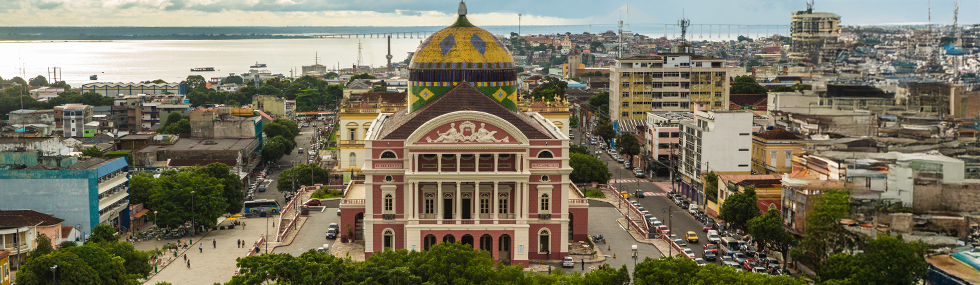
The mighty Amazon River system, which in size and number of tributaries has no equal, holds one fifth of the planet’s fresh water. In the heart of the Amazon Basin is the confluence of the Rio Negro and Rio Solimões, which, after flowing side by side for about 8km without their waters mingling, join to form the Amazon proper. Situated at this meeting of the waters, an island of civilisation in the middle of the jungle, Manaus is a town that flourished during the late 19th century and became the second Brazilian city to have electric light. The city is now the capital of the state of Amazonas and the main port, having recently acquired renewed importance as a free trade zone and industrial centre, and as the natural focus for tourism in this exotic region.
The rubber boom, which started at the end of 19th century and lasted for about 30 years, was largely responsible for the way Manaus looks today, with its broad avenues and squares. The opulent wealth of this period bequeathed some jewels which cannot be missed during a stay in the city, such as the Teatro Amazonas, built in Italian Renaissance style, completed in 1896 and restored in 1929 and 1990, the Alfredo Lisboa market, designed by Eiffel following the example of Les Halles in Paris, the Rio Negro Palace, today the seat of the state governor and the Alfândega (customs building), designed and built in Liverpool, transported, and assembled in Manaus. Also erected in this way were the floating docks, an ingenious design at the time, made to cope with the 14-metre annual rise and fall of the Rio Negro.
Manaus is a natural starting point for tours into the jungle. The Amazon rainforest is largely low-lying, much of it being periodically flooded and the main transport is by boat. Tourists also use this means to get to know the exuberant vegetation and diverse wildlife of the region, home to a tenth of the world’s 10 million recorded species of living things. Among them are 2000 species of fish, 8600 species of bird, 1800 species of butterfly, 50,000 higher plant species and countless species of insects. A number of jungle lodges are specially designed to offer the opportunity to encounter nature close at hand. For the more adventurous, regional boats can take visitors further upstream: The upper Rio Negro leads to the spectacular Anavilhanas Archipelago and the Jaú National Park, whilst the Rio Solimões is the route to the Mamiraua Jungle Reserve near Tefé; and Peru.