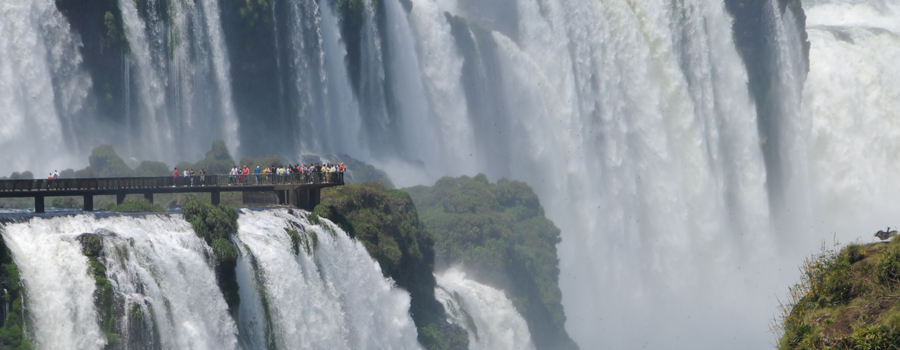
Iguaçu means ‘great river’ in the indigenous Guarani language and there could hardly be a more fitting name. After rising in the Brazilian highlands near Curitiba, the Iguaçu river runs westward on a 1100km journey, receiving some 30 tributaries on its course to the plateau where, just before merging with the great Paraná river, it plunges thunderously over an 80m high cliff in virgin forest. The Iguaçu falls are the most spectacular in South America. A total of 275 falls cascade over a precipice that is 3km wide, sending up an endless wall of spray laced with rainbows. At the heart of this unforgettable scene is the Devil’s Throat, where 14 separate falls join forces. The visitor can enjoy the spectacle from the various walkways that offer close-up views, by boat or; for the most exhilarating experience of all; by helicopter.
Iguaçu is also the meeting point of three countries: Brazil, Argentina and Paraguay. Straddling the Iguaçu River, the twin National Parks of Foz do Iguaçu were set up to preserve the precious environment. In addition to providing different perspectives on the falls, both the Brazilian and Argentine sides thus offer the opportunity to safely visit a real rainforest, home to over two thousand plant varieties, four hundred bird species, dozens of types of mammals and innumerable insects and reptiles. For the longer stay, the Yacutinga Jungle Lodge is an excellent base.
Near Iguaçu the Brazilians have created their own miracle: the Itaipú hydroelectric plant on the Paraná River is the world’s largest single power station. 18 turbines provide Brazil with over 12,000MW, one third of its electricity. In addition to becoming a tourist attraction in its own right, the dam brought about the building of the town of Foz do Iguaçu, which has flourished with tourism and trade with the neighbouring countries. Ciudad Del Este, in Paraguay, is a favourite bargain-shopping destination among Brazilians.
As well as these natural and technological wonders, there is a cultural spectacle in the form of the Gaúcho, or South American cowboy, symbolized by typical dress and chimarrão, a tea based on herbs, which is drunk from a special pot. The history of this region also provides an interesting attraction in the form of the ruins of the Jesuit missions that featured in the film ‘The Mission’, a vivid account of this dramatic chapter in the conquest of the New World. The ruins of the Santo Inacio mission are just a short trip into Argentina.